
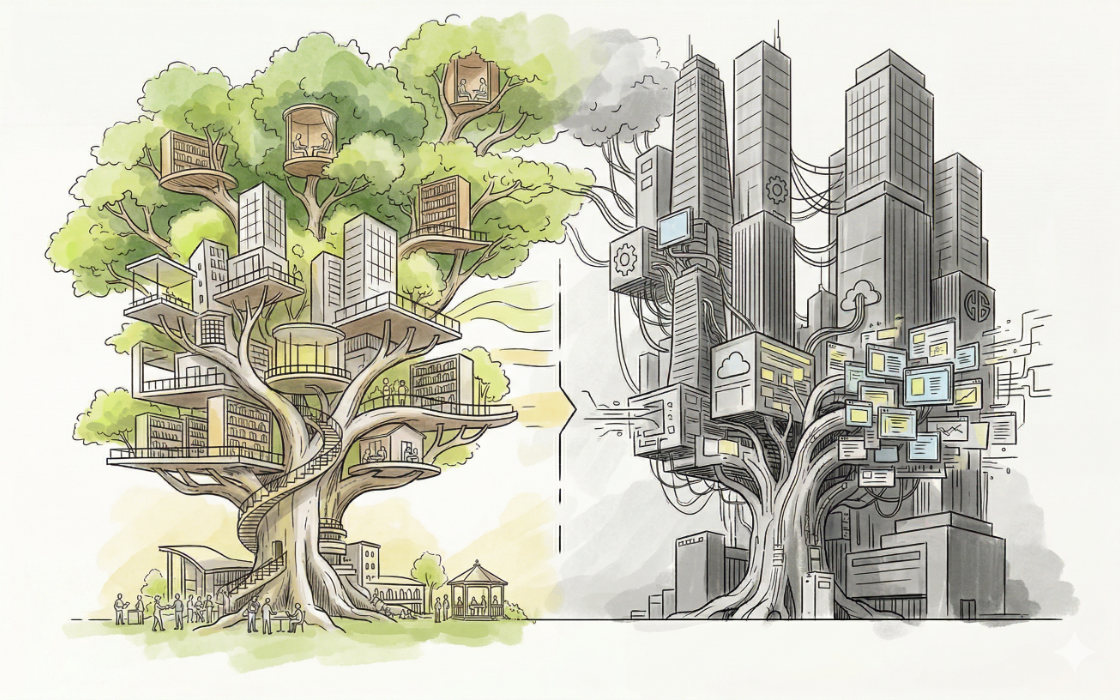
There are moments when you sense that something is fundamentally shifting – not loudly, not with some grand announcement, but gradually, until one day you realise that the web you once knew has become something else entirely.
I’ve worked in the web for over ten years, with WordPress, with open source, with projects focused on building digital spaces that actually work – for people, not for algorithms. In that time, I’ve seen a lot change, some of it for the better, much of it in directions that give me pause.
The web was once a promise: open, decentralised, accessible to everyone, without a corporation deciding what gets seen or a monopoly determining which voices get heard. An infrastructure that belonged – if not to everyone, then at least to no single entity. That promise isn’t dead, but it’s under pressure, and that pressure has become harder to ignore in recent years.
Platforms haven’t replaced the web – they’ve overlaid it
For many people, the web today is synonymous with Facebook, Instagram, or TikTok – not a collection of websites, but a handful of surfaces that decide what’s relevant and what isn’t. If you don’t exist there, for many people you simply don’t exist. This isn’t a new problem, but it’s intensifying, and it’s taking on new dimensions: AI systems train on content the open web has produced over years, then return results without making the origins visible. Search engines answer questions directly rather than pointing to the sources those answers came from. The web gets read and processed, but the connection to what sustains it grows weaker in the process.
At the same time, a large share of the digital infrastructure the web runs on sits in the hands of a small number of companies – cloud providers, browser makers, platforms. Whoever controls the stack ultimately controls what’s possible, and that concentration of power is something our industry still talks about far too little.
Why I’m not giving up on it
I could end on a pessimistic note here, but that wouldn’t be honest – because at the same time, there are more people taking these questions seriously than I would have expected a few years ago. People running their own blogs under their own domains, their own servers, their own newsletters, because they’ve understood that digital independence isn’t a luxury but a deliberate choice. People using Mastodon because they’ve genuinely thought through the logic of decentralisation, and contributing to open-source projects not because they’re paid to, but because they believe it matters.
The web isn’t lost – it’s contested, and that’s a distinction worth holding on to.
In that context, having your own voice makes sense to me, not as a content strategy but as a stance. This blog is my attempt to express that: what I observe, what I think, what occupies my mind – around web technology, open source, WordPress, and digital independence, and always returning to the question of how we shape the web we actually want. These won’t be finished answers, but they’ll be honest thoughts.
I’m glad you’re here.
Leave a Reply