There are decisions on the web that look technical on the surface but are really about something far more fundamental. Your own domain is one of them.
I see it regularly: someone builds a presence online, invests time, energy, sometimes money – but the actual anchor point is missing. Everything runs through platforms. Instagram, LinkedIn, a subpage on some third-party system, maybe a Linktree somewhere. It sounds pragmatic. But it’s often a slow, steady loss of control.
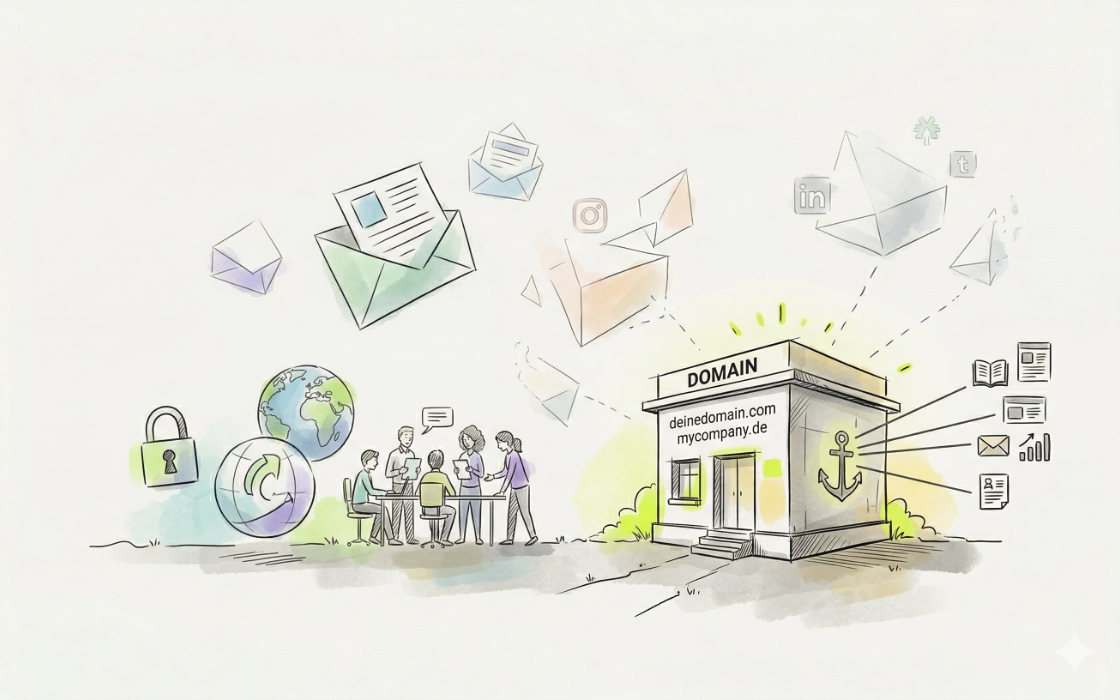
Your own domain is not a technical nicety. It’s the address where you’re reachable on the web – regardless of which platform is trending right now, which terms of service change tomorrow, or which service no longer exists in five years. It’s the only piece of digital infrastructure that truly belongs to you.
What a domain actually means
When I talk to clients or colleagues about their digital presence, I notice how rarely the domain is treated as a strategic asset. It gets ticked off as a necessary formality – “yes, we registered one somewhere” – and then forgotten.
But it’s the opposite of that. A domain is continuity. It’s the ability to publish content that doesn’t disappear when a platform changes its rules. It’s the foundation for an email address that feels professional and isn’t tied to a free provider. It’s the place you send people when you want them to see something specific – not whatever an algorithm happens to surface that day.
In short: it gives you room to act.
Platforms come and go
I’ve been around on the web long enough to have watched what happens when platforms shift or disappear. MySpace. Flickr in its original form. Google+. Tumblr after the rule changes. Twitter, which barely resembles what it once was. Each time, people lost reach, connections, or content they had built on someone else’s system.
That’s not an argument against social networks or platforms – I use them myself. But it is an argument for making your own digital space the first priority. Platforms are distribution channels, not a home.
And that’s precisely what makes your own domain so important. It’s the place that remains, whatever happens on the platforms.
Sovereignty starts small
Digital sovereignty sounds like a grand concept. In practice, though, it begins with small decisions. Where does my content live? Who owns my email address? What happens to my online presence if I switch providers?
A domain of your own is the first step. Not the only one, but a decisive one. Whoever controls that has a foundation everything else can be built on.
I’m not saying this to ride a trend or because it sounds good. I’m saying it because I’ve seen what happens when that step is missing – and how much easier things become when it’s there.
Practically speaking
A domain costs very little. In most cases it’s ten to fifteen euros a year for a .de or .com domain. For that, you get the foundation for an independent online presence, a professional email address, and the ability to publish content that genuinely belongs to you.
What many people underestimate: the domain is also a signal. It shows that someone is thinking long-term. That their own presence is being taken seriously. That they’re not just reacting on platforms but have a place of their own.
For freelancers, small businesses, anyone building something on the web – your own domain should be the first step, not the tenth.
A final thought
The web is an open system. It was built on the idea that anyone can have their own place on it. Not just large companies, not just platforms. Anyone.
Your own domain is the simplest way to take that idea seriously. It’s not a detail. It’s the beginning.