There is a sentence that comes up in almost every initial conversation. Sometimes directly, sometimes in passing, sometimes a little apologetically. It does not need to be anything complicated. Just a simple website.
I understand this sentence better today than I did ten years ago. It rarely expresses a wish for simplicity in a craftsmanship sense. More often it expresses the hope that things might be quick, affordable and free from too much back and forth. Simple in the sense of low effort. Simple in the sense of please do not ask too many questions.
But this is exactly where the misunderstanding begins. A truly simple website is almost never the result of a quick process. It is the result of many small, deliberate decisions that have become invisible in the finished product.
What has changed
Ten or fifteen years ago, a simple website was actually closer to what many people still mean today when they use the word. A few pages, a contact form, a theme from the directory, a hosting plan, done. Expectations around performance, data protection, accessibility, legibility across devices and visibility in search engines were modest.
That world no longer exists. A website today is read on phones, tablets, laptops, large monitors, through screen readers and occasionally in the chat windows of AI systems. It should load quickly, use as little data as possible, stay legally clean, work without an exhausting cookie banner, remain findable in search engines and ideally still be maintainable five years from now. None of this is complicated because someone is making it complicated. It is simply the state of the web today.
The demands have not become louder. They have grown quietly in the background, while the expectation around the effort has stayed where it was.
Simplicity as a result, not a starting point
When I look at projects that truly feel simple today, I notice every time how much work has gone into creating that exact impression. Navigation that works without explanation has usually been rebuilt several times. A homepage that makes its purpose clear in two sentences often has weeks of writing behind it. A layout that feels calm on every device is the opposite of a theme that was simply taken over.
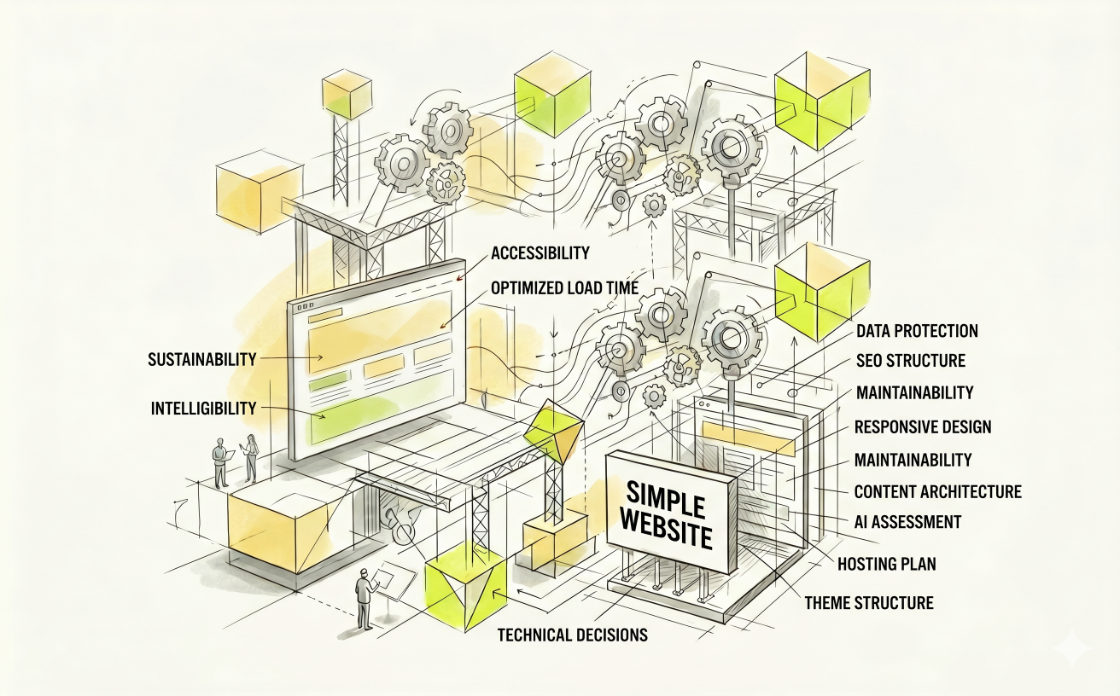
Simplicity on the surface comes from complexity in the preparation. Content structure, technical decisions, the choice of the right tools, leaving out everything that is not needed. This work is not visible, which is why it is so often underestimated.
I experience the same with my own projects. My blog looks fairly modest from the outside. Behind that modesty are decisions about hosting, theme structure, permalink logic, multilingual setup, tracking, analytics, typography, image sizes and content architecture. None of it is spectacular. But the interplay is what makes the difference between a site that feels simple and one that is merely reduced.
Reduced is not the same as simple
This may be the point where the misunderstanding becomes most visible. A website with little content is not automatically simple. It is, first of all, just empty. A website with few features is not automatically clear. It only has fewer features.
Simplicity has to do with intelligibility, inner logic and consistency. A truly simple site answers the questions visitors bring with them without forcing them to search. It guides through its content without putting itself in the foreground. It works on slow connections, on older devices, with a keyboard, with a screen reader. That is not reduction. That is care.
And then there is AI
On top of all this, a new expectation has entered the conversation. With today’s AI tools, almost anyone can produce something in a short amount of time that looks like a finished website at first glance. Layouts, copy, images, even working components appear within minutes. That is impressive, and I have no interest in playing it down. A lot of it is genuinely useful.
What can easily get lost, though, is the question of what a website actually needs to fulfil beyond that first impression. A site can look good and still not be accessible. It can feel modern and at the same time load far more data than it should. It can sound plausible in its wording and still miss the actual audience. It can work technically today and become difficult to maintain six months from now.
A generated result often looks finished long before it really is. Anyone who does not know what to look for cannot recognise the gap. This is not a criticism of the tools, but an observation about what expertise actually does. It is not visible in the result itself, but in the ability to judge a result. That judgement is what separates a website from a first draft.
Simple in the sense of “built in two hours with AI” is therefore something different from simple in the sense of well considered. Both can have their place. It is just worth not losing sight of the difference.
What I sometimes wish for
I wish the word simple would be spoken more slowly in these conversations. Not as a synonym for cheap or quick, but as an honest description of what the final result should be. A site that is simple to use. Simple to understand. Simple to maintain. Simple to find.
If that is what is meant, it becomes a lovely task. It is only rarely a short one. And that is fine, as long as both sides know what they are signing up for.